
Forkable Claude Code Marketing Workbench
I package my 10+ years of running marketing GTM for early stage tech products into a forkable repo with reusable skills, agents, and workshops

Table of Contents
[Demo] How I actually use it (there’s a Loom video walkthrough)
I built tech-marketing-framework because I wanted a better way to use AI for real marketing work.
Not “write me a post” in a blank chat box, generic AI dashboard, or bloated Projects. (Wrote about my full thoughts on the form factor of AI at work here.)
I wanted a setup I could actually work inside every day.
Something grounded in the product, the audience, the positioning, and the proof. Something reusable. Something I could keep improving instead of rebuilding from scratch every time.
The inspiration for the usage pattern
You know how engineers work in their IDE (e.g. Cursor, Visual Code Studio, etc) or terminal all day with directory structures that can be shared, check in and out, and merged via Git? I really like that pattern and the interrogation of the form factor led me to an experiment in “marketing as code”.
That led me to build this template repo.
You fork or clone it, fill in a small set of docs about your product (Claude is entirely capable to auto-generating this if you point it at documentation, website, even just local repos…something that reflects a high fidelity information of your product), open it in Cursor, and use Claude Code in Cursor terminal through a library of composable skills for recurring marketing jobs.
Sorry I don’t know how to compress that chunk of what it does down more. It sounds highly technical I know. But I promise the learning curve is a small hill and once you climb it the view took my breath away. It feels like flying.
What is tech-marketing-framework?
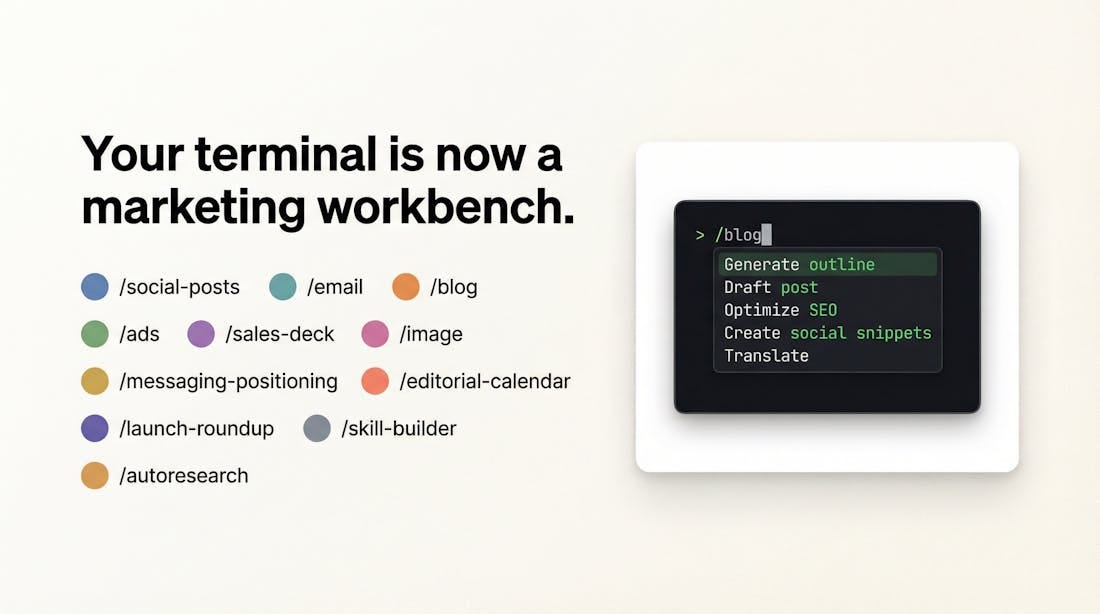
It’s a repo that contains 11 skills + 3 agents + framework and chained workflows for Claude Code that helps you generate:
Social posts (with images for LinkedIn carousels wow!)
Blog posts
Email sequences
Launch roundups
Interactive messaging & positioning workshop following April Dunford’s approach
Ads
Sales decks
Editorial planning
It’s a complete operational setup that turns one person into a machine. It is the setup I use every day.
Want to skip the parts on the build and try it out for yourself? Jump to the end of try it!
Why I built it this way
Most AI marketing workflows still start in a chatbox.
You ask for a blog post or a launch thread, and hope the model can improvise enough context to sound competent. And hey frontier models are really good so sometimes it works.
But other times, it gives you generic positioning, fake specificity, weak proof, and copy that sounds like every other AI-assisted company.
Prompt engineering will not save you.
If you want better output, the model needs a better working context. Context and memory is everything.
For me, that means a repo with:
A product brief
Target personas
Messaging and positioning
Competitor intel
Testimonials
Brand guidelines
Those docs act as the grounding layer.
Then on top of that, the framework has reusable skills for recurring marketing jobs.
The important part is that the skills read the product docs before they generate anything. Anything that is a repeatable task in marketing can be composed as a skill. All skills can be iteratively optimized via evals (I adapted Karpathy’s autoresearch as a skill in the repo for the extremely AI-pilled among you) and best practice reference files.
That sounds obvious, but it changes the output quality a lot. Instead of asking the model to freestyle your company from scratch, you are giving it actual context to reason from. That leads to work that is:
Hyper specific
Less slop-y
Easier and faster to edit
Reusable and continuously improving skills for repetitive tasks!!!
Less likely to hallucinate product nonsense
How I actually use it
I use this thing every day.
The repo has become my template. Locally, I keep different directories for different projects. I open them in Cursor, which is my workbench, and work with Claude Code inside that environment.
When I build a new skill and it proves genuinely useful, I commit it back to the main repo so I can reuse it later and keep the best practices fresh.
That matters a lot to me.
I do not want good workflows trapped in random chat transcripts. I want them versioned, reusable, and easy to improve.
Here’s a Loom (my very first!) of me starting fresh from the repo and working through a workflow for social post + carousel.
The skills I use the most right now are:
Social post + carousel
This is the one I hit most because social needs to be fed constantly. The value is not just speed. It is consistency. The framework can pull from the product context and produce something that sounds much closer to how I actually want to talk about the product.
Launch roundup
This is one of the most practical skills in the repo. It takes one launch input and turns it into a usable package of outputs instead of making me manually reshape the same announcement over and over. That is exactly the kind of repetitive work AI should be eating.
Blog
Long-form is where weak context gets exposed fast. If the model does not understand the product, the market, the proof points, and the angle, you feel it immediately.
The blog skill is useful because it starts from real source material and gets me much closer to a serious first draft. Not finished. But absolutely closer. Having a draft worth editing from AI is a giant step forward. (I can’t tell you the rage I feel when I’m reviewing AI generated slop…put some respect on my and the readers’ time and intelligence smdh).
Just launched on Product Hunt! Some ideas for improvement…

I launched my little repo on Product Hunt over the weekend, and the launch itself is not really the story (even though I fucking love launches lol).
What mattered was the the feedback. Builders, devs, and solopreneurs clearly resonated with the core pain: they know distribution matters, they know AI can help, and they do not want to manually grind through repetitive marketing work from scratch.
The biggest pushback was also useful: a lot of people wanted the value, but not everyone wanted to operate through Claude Code and the terminal. Fair. That tells me:
The problem is very real
The interface still narrows the audience
I’m brainstorming now how to ship a more generalized version of the repo that makes it accessible to non-technical audiences. I don’t have a good solution in mind yet so let me know if you have thoughts!
If you want to try it
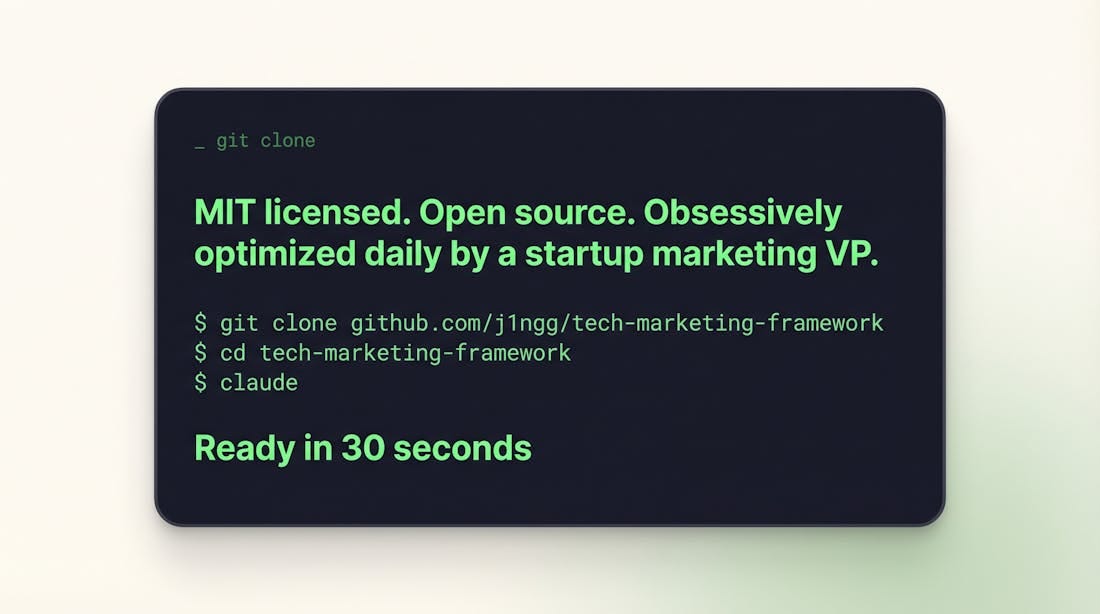
If you are already using Claude Code, or you are curious about what a more grounded AI marketing setup looks like, you can fork the repo and make it your own. Claude can walk you through the setup cloning and usage.